Case Study
The Making of Japanese Art History
Website design and front-end build for an international graduate symposium hosted at Heidelberg University.
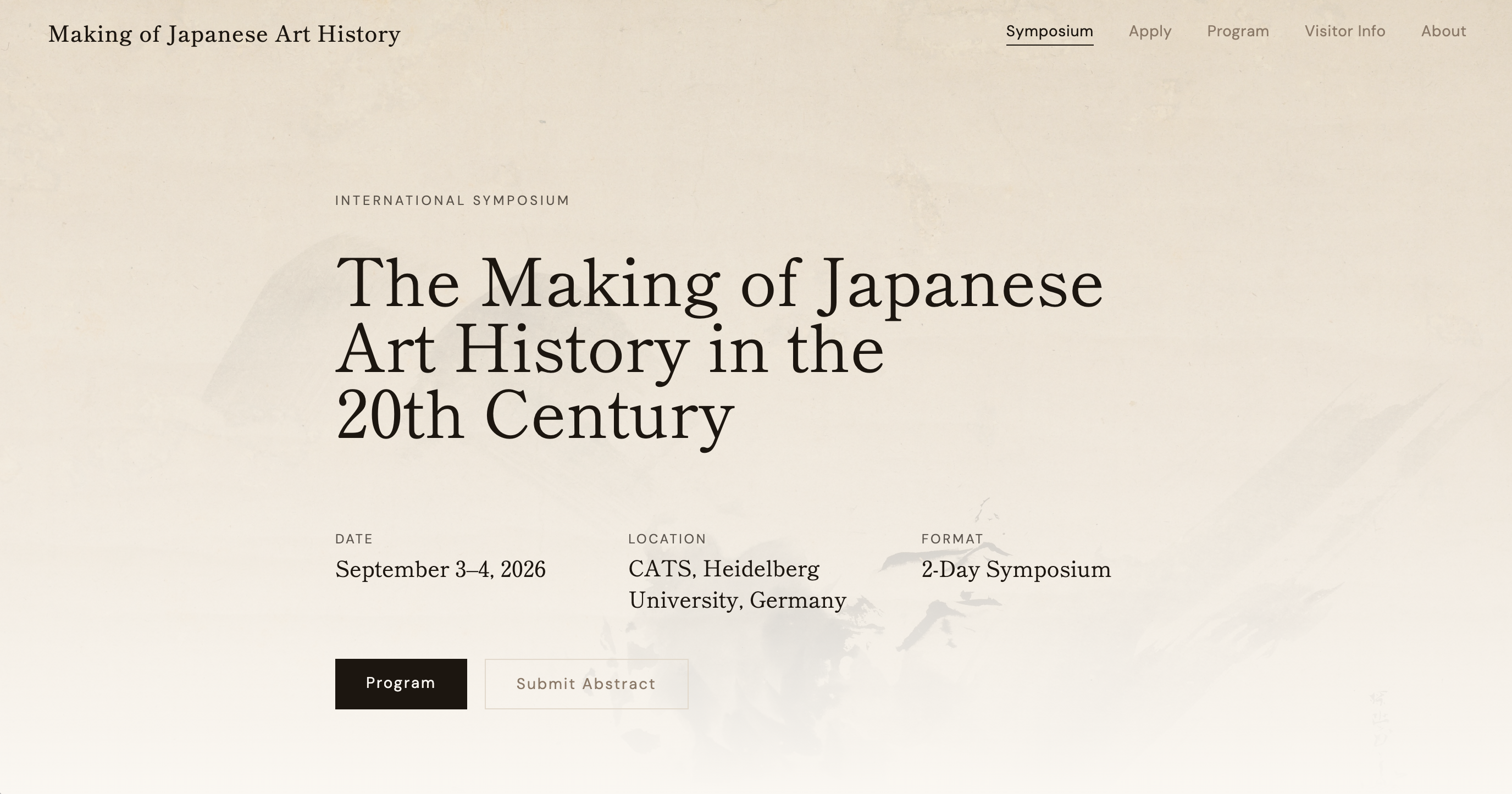 Visit Live Site ↗
Role
UI/UX Designer, Front-End Developer & Academic Copy Editor
Tools
React, Next.js, Tailwind CSS
Timeline
2026 — for a Sept. 3–4 symposium
Overview
The site is the public home for a two-day graduate symposium on the historiography of Japanese art — a Call for Papers, a full two-day program, fifteen paper abstracts and three keynote talks, and practical visitor information for attendees traveling to Heidelberg. The brief was simple to state and hard to execute well: make a content-dense academic program feel legible, credible, and easy to navigate, without losing the editorial character the subject deserves. Beyond the interface, I worked closely with the symposium committee through several rounds of review to align on the visual direction, and — drawing on my own academic background — proofread the Call for Papers and program copy for tone and precision.
Highlights
See the highlights of this website
Homepage
A slow fade-in welcomes visitors on load, instead of the page snapping into view.
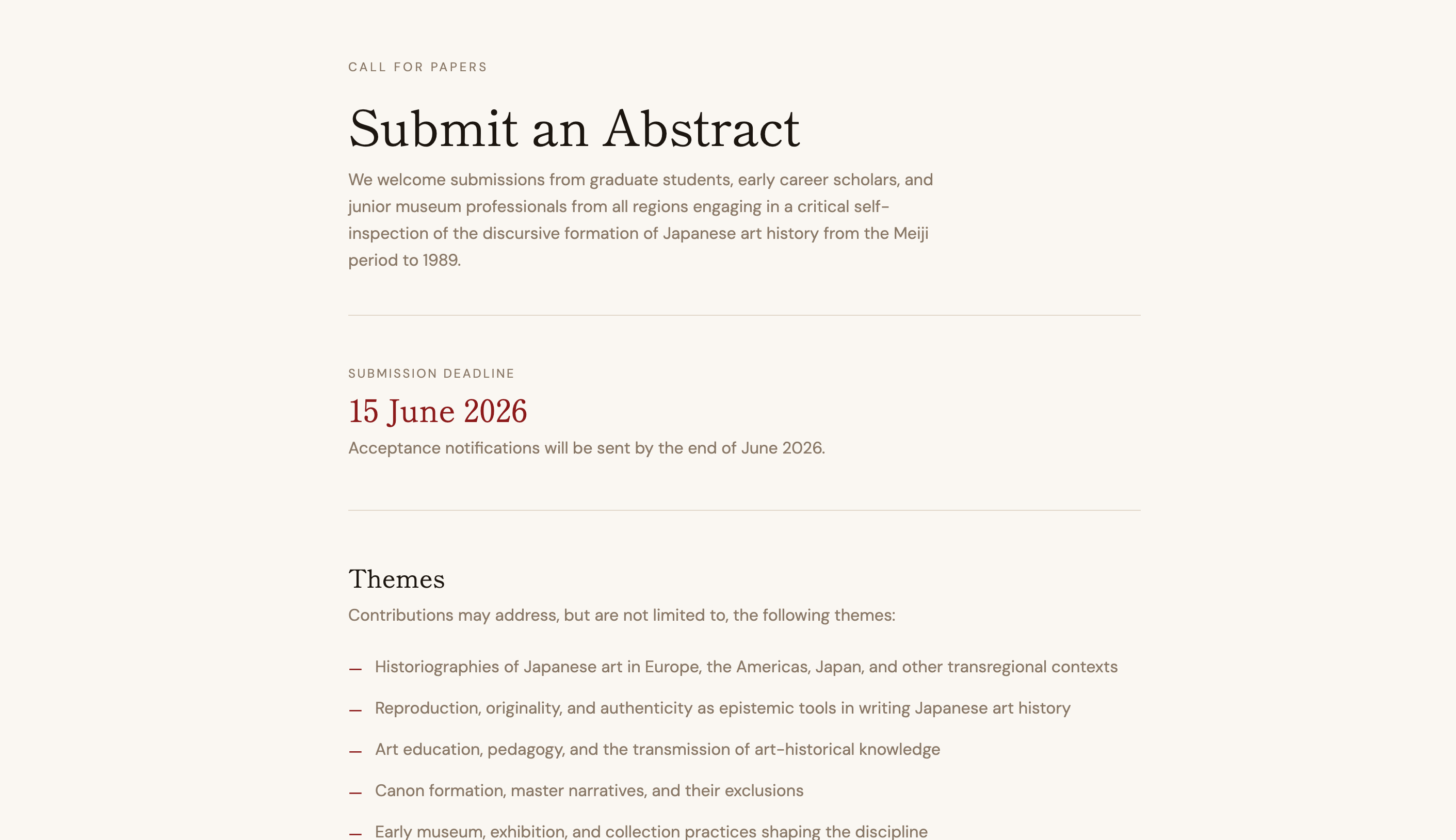
Call for Papers
A clear submission brief with themes and deadline up front, so contributors know at a glance if and how to apply.
Program — Ensō Orientation
A hand-drawn ensō appears while reading the abstracts and jumps straight back to the schedule.
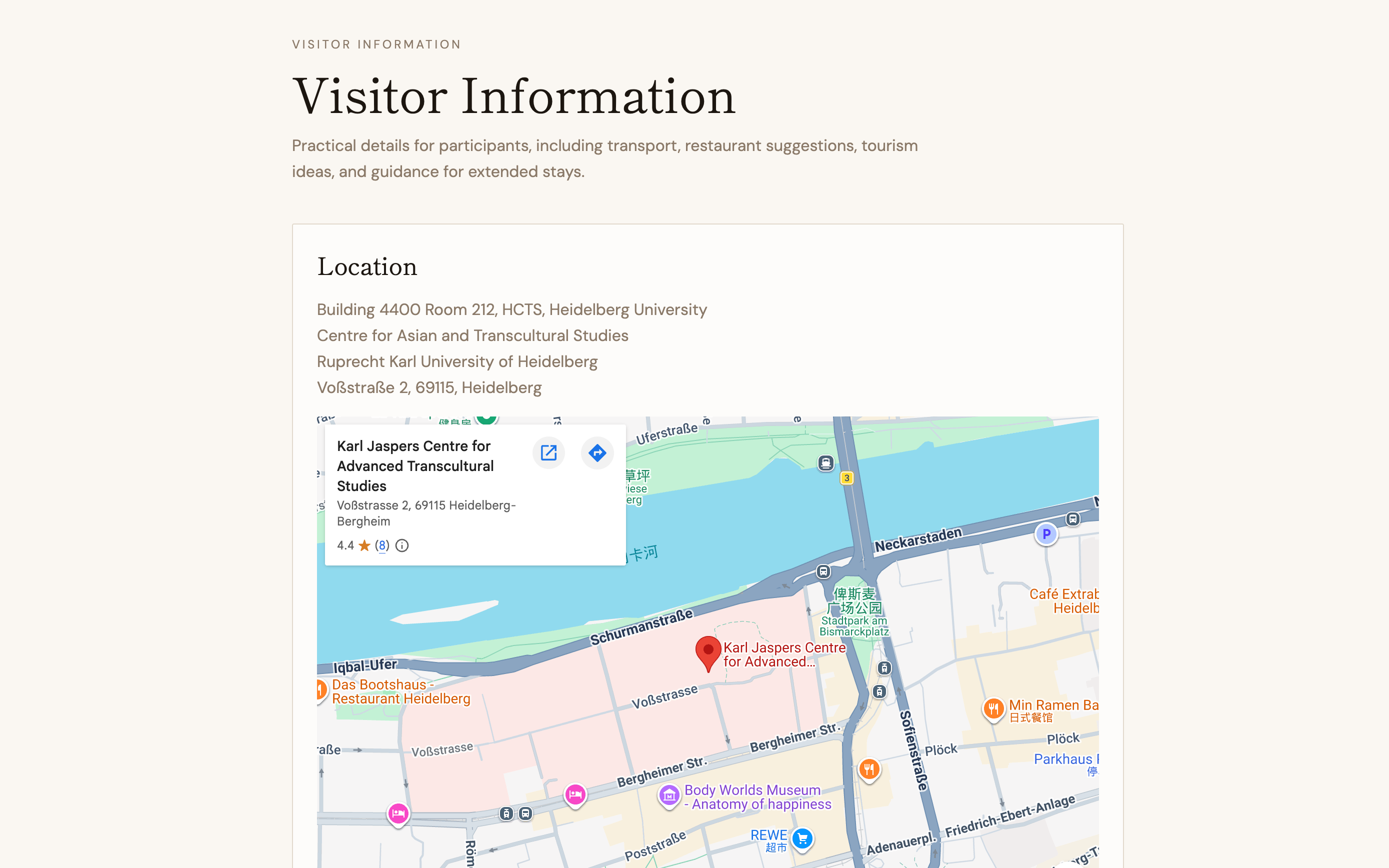
Visitor Information
An embedded Google Maps view sits directly on the page, so attendees can find the venue without leaving the site.
Type & Color
Headings — Shippori Mincho
歴史 History
Weights used: Regular 400, Medium 500
Body — DM Sans
Aa Bb Cc — 0123
Weights used: Regular 400, Medium 500
Paper
#FAF7F2
Ink
#1C1610
Stone
#8A7968
Parchment
#E2D9CC
Vermillion
#8C1A1A
Outcome
The site shipped ahead of the Call for Papers deadline and now hosts the full program: three keynote talks and fifteen papers from scholars and institutions across Europe, North America, and Asia. The cross-linked schedule/abstract structure meant zero duplicated content to maintain, and the plain-data architecture let organizers update speaker details themselves without touching layout code.
Interested in working together, or want to see more of the process behind this project?
Get in Touch